Inspection And Cutting Of Film
Accuracy at the Cutting Stage Defines the Entire Garment
The Critical Role of Fabric Inspection and Precision Cutting
The cutting room is where design specifications become physical reality. At TTgarment, we treat fabric inspection and cutting as one of the most consequential stages in the entire manufacturing process. A deviation of even a few millimeters at this stage can cascade into fitting problems, pattern misalignment, and wasted material across an entire production run. Our cutting department operates with military-level precision to prevent exactly that.
Pre-Cut Fabric Inspection
Before any fabric is laid on the cutting table, it passes through our four-point fabric inspection system — an industry-standard method that assigns penalty points to defects based on their size and severity. Our trained inspectors examine every meter of fabric for weaving defects, holes, stains, shading variations, and selvedge irregularities. Fabric that exceeds the acceptable defect threshold is quarantined and returned to the supplier or downgraded for use in non-critical components.
Marker Making and Lay Planning
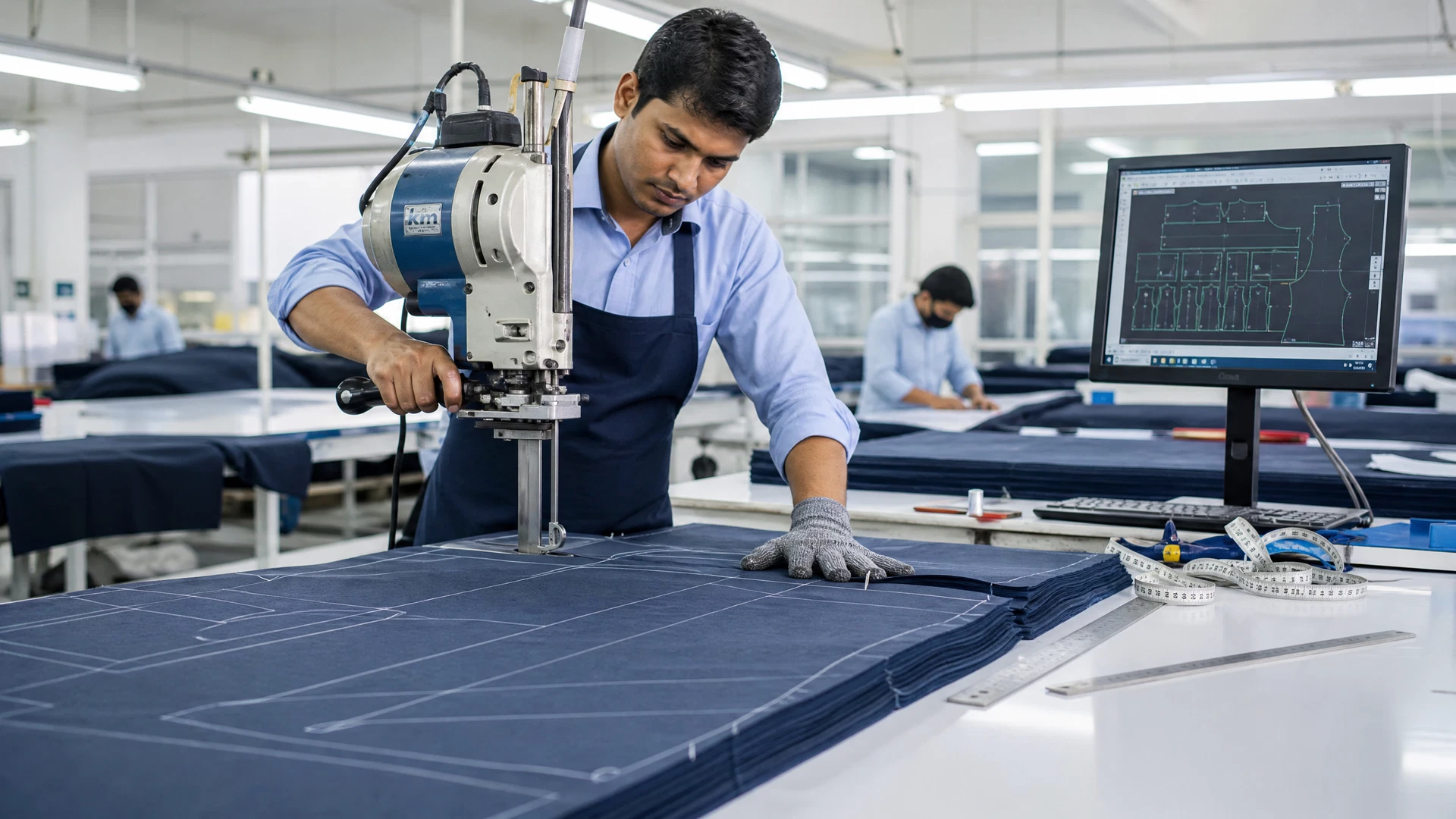
Our pattern-making team uses CAD software to create optimized cutting markers that maximize fabric utilization while strictly respecting grain lines, pattern repeats, and directional requirements. For fabrics with stripes, checks, or engineered prints, our lay planning accounts for pattern matching at seams — a detail that separates premium garments from average ones. Marker efficiency is reviewed and approved before any fabric is spread.
Precision Cutting Execution
Fabric is spread on long cutting tables in multiple plies, with each layer checked for alignment and tension before cutting begins. We use computer-controlled straight-knife and band-knife cutting machines for straight cuts and curves respectively, ensuring consistent accuracy across every ply in the lay. Cut panels are immediately bundled, labeled with size, color, and order information, and transferred to the sewing floor in sequence to maintain production flow.
Zero-Tolerance for Cutting Defects
Cut panels undergo a secondary inspection before leaving the cutting room. Any panel with notch errors, incorrect grain direction, or dimensional deviation beyond tolerance is rejected and re-cut from reserve fabric. This zero-tolerance policy at the cutting stage protects the integrity of every subsequent production step and ultimately ensures that the finished garment fits exactly as designed.